

Understanding the Pen Peptide Delivery System in Modern Research
In laboratory settings, the integrity of research data is paramount. A pen peptide system is a pre-filled, multidose delivery device containing a stabilized, liquid research-grade peptide. This technology represents a significant evolution from traditional lyophilized powders, offering a ready-to-use solution designed to enhance precision and efficiency. The core components include a durable polymer housing, a sealed 3ml cartridge containing the peptide solution, and a calibrated dial mechanism for precise dose selection. It is critical to note that these systems are intended exclusively for in-vitro laboratory research and analytical testing, not for human or veterinary applications.
The Mechanics of the Research Pen
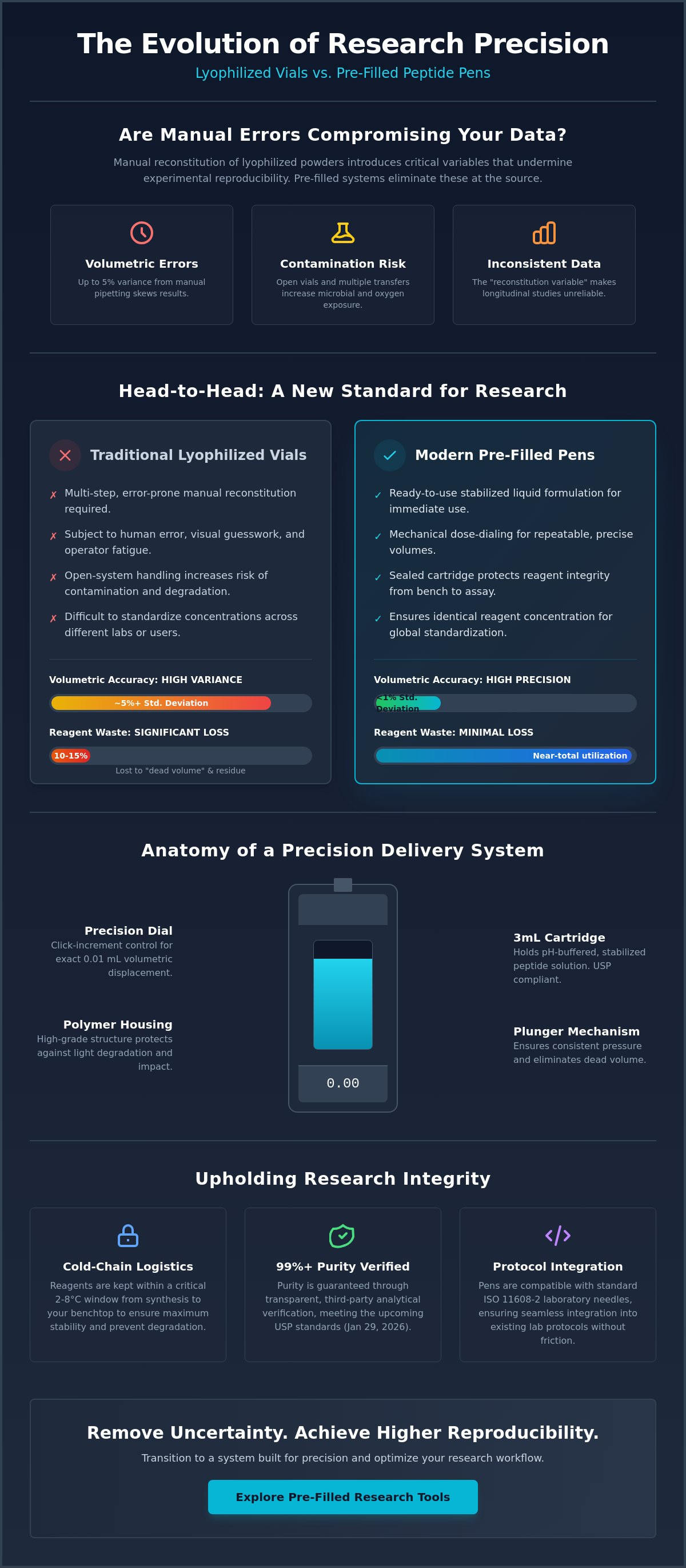
The functionality of a research pen is rooted in its mechanical precision. An internal plunger mechanism applies consistent pressure with each actuation, ensuring a uniform delivery volume. The dose-dialing system allows researchers to select volumes in precise increments, often as small as 0.01 mL, which is crucial for micro-scale experiments. This mechanical control eliminates the guesswork and potential for human error associated with manual pipetting. For compatibility, these pens are designed to work with standard pen needles that conform to ISO 11608-2, a widely adopted standard for medical injection devices.
Why Laboratories are Phasing Out Manual Reconstitution
The transition away from manual reconstitution is driven by the need to eliminate variables that compromise experimental validity. Manual reconstitution of lyophilized powder introduces risks such as volumetric inaccuracies, potential contamination during mixing, and inconsistent concentrations. For longitudinal studies or protocols replicated across multiple lab sites, this "reconstitution variable" can undermine the reproducibility of results. Pre-filled pens standardize reagent concentration from the point of manufacture, ensuring that every researcher begins with an identical, verified solution.
Volumetric Accuracy: The Scientific Case for Pre-Filled Pens
In quantitative in-vitro studies, even minor pipetting errors can cascade into significant deviations in results, impacting data reproducibility. The mechanical nature of a pen peptide system directly addresses this challenge. The dose-dialing mechanism is calibrated to deliver a specific volume with each click, removing the visual estimation and manual dexterity required for traditional syringe or pipette use. This precision not only improves data quality but also minimizes reagent waste by allowing researchers to dispense the exact amount required for an assay, down to the microliter.
Precision Dialing vs. Manual Pipetting
Click-increment accuracy refers to the pen's ability to dispense a metered, repeatable volume corresponding to each audible and tactile click of the dose dial. Comparative analyses consistently show that the standard deviation in volume delivered by a pen system is significantly lower than that of manual syringe aspiration and delivery. Advanced cartridge designs, such as those featuring a 'Short Stopper,' further enhance this accuracy by preventing the formation of air gaps that could otherwise lead to incomplete dosing.
Data Integrity and Reproducibility
For multi-researcher laboratories, inter-operator variability is a known challenge. By standardizing the delivery method, pen systems reduce this variability, ensuring that results are comparable regardless of who performs the experiment. When working with high-potency peptides like Cagrilintide or SS-31, ensuring that every aliquot contains the exact molar concentration is non-negotiable. Pre-filled pens provide a reliable method to maintain this consistency, strengthening the integrity of the final data set.
Pre-Filled vs. Lyophilized: A Stability and Purity Analysis
A common objection to pre-mixed solutions is the concern over long-term stability compared to lyophilized powder. However, modern formulation science has largely overcome this challenge. Through the use of advanced stabilizers, pH buffering strategies, and bacteriostatic agents, liquid peptide solutions can maintain their structural integrity and potency for extended periods under proper storage conditions. The benchmark for high-quality research reagents in 2026 and beyond is a verified purity of 99% or greater, a standard that reputable manufacturers like Metatide Healthcare consistently meet.
| Attribute | Lyophilized Powder | Pre-Filled Liquid Pen |
|---|---|---|
| Purity Verification | Verified at time of synthesis; post-reconstitution purity depends on lab protocol. | Verified in final stabilized solution; sealed to prevent contamination. |
| Volumetric Accuracy | Dependent on technician skill with pipettes/syringes; high potential for error. | Mechanically controlled via dose dial; high precision and reproducibility. |
| Risk of Contamination | High risk during reconstitution with bacteriostatic water or other solvents. | Minimal risk; system is sealed until the first use. |
| Prep Time | Requires calculation, measurement, mixing, and loading. | Ready for immediate use. |
| Stability | Excellent long-term stability as a powder; degrades after reconstitution. | Stable for 24+ months under refrigeration due to pH buffers and preservatives. |
Stabilization Protocols for Liquid Peptides
To ensure stability, pre-filled research pens utilize a multi-faceted approach. Bacteriostatic agents, such as benzyl alcohol or m-cresol, are included to prevent microbial growth in the multi-dose cartridge after the septum is first pierced. The solution is carefully buffered to a specific pH to maintain the peptide’s isoelectric point, which prevents aggregation and precipitation. Rigorous stability testing protocols confirm that these formulations maintain their potency for 24 months or more when stored under recommended refrigeration (2-8°C).
Verifying Purity via HPLC and MS
For credible research, purity verification is non-negotiable. High-Performance Liquid Chromatography (HPLC) is used to separate the target peptide from any impurities, providing a quantitative measure of purity. Mass Spectrometry (MS) complements this by confirming the molecular weight of the peptide, thus verifying its identity. Researchers should demand independent, lot-specific testing data for every reagent they purchase. This level of documentation ensures that the material used in an experiment is exactly what it purports to be.
Logistics and Handling: Preserving the Cold Chain
The efficacy of a pre-filled peptide solution is contingent upon maintaining its integrity from the manufacturing facility to the laboratory. Peptides are temperature-sensitive macromolecules, and exposure to heat can cause denaturation and loss of function. The critical temperature window of 2-8°C must be maintained throughout shipping and storage. This requires a specialized logistics infrastructure known as a cold chain.
The Anatomy of Cold-Chain Shipping
Effective cold-chain shipping relies on advanced packaging technology. This often includes vacuum-insulated panels that minimize thermal transfer and phase-change materials (specialized gel packs) calibrated to maintain the 2-8°C range for the duration of transit. A temperature excursion, or deviation from this range, can irreversibly damage a peptide's secondary and tertiary structures, rendering it useless for research. Companies like ReadyPep utilize a global distribution model from the United Kingdom, employing these technologies to ensure product integrity upon arrival worldwide.
Sterile Laboratory Storage Protocols
Upon receipt, proper laboratory handling is essential. Pre-filled pens must be immediately transferred to a laboratory refrigerator. It is also best practice to store them in their original packaging to protect them from light, which can induce degradation in some peptides. Always observe the lot-specific expiration date printed on the device. Once a cartridge is depleted, the entire disposable pen system should be discarded in accordance with laboratory biohazard standards.
Sourcing Validated Pen Peptides: What to Look for in a Supplier
When procuring research materials, the supplier's commitment to transparency and quality control is as important as the product itself. A trustworthy supplier provides clear, accessible documentation for every batch. ReadyPep, for example, builds confidence through a partnership with Metatide Healthcare for manufacturing and ensures every lot is independently tested by a third-party lab like Janoshik Analytical.
Independent Verification with Janoshik
Third-party testing is the gold standard for ensuring purity and identity. Researchers should know how to read and interpret a Janoshik report, which provides HPLC and MS data confirming the peptide's purity and molecular weight. A key trust signal is the use of lot-specific QR codes on product packaging, which link directly to the corresponding analytical report. This direct, verifiable link between the physical product and its documentation is the only way to be certain of receiving a reagent with 99%+ purity.
Streamlining Lab Procurement
For labs conducting longitudinal studies or high-volume screening, sourcing can be a significant logistical task. Suppliers that offer peptide bundles or curated stacks can streamline this process, ensuring a consistent supply of reagents from the same validated batches. When navigating a supplier's catalog, look for clear categorization by research target (e.g., Semax, MOTS-c) to quickly find the necessary materials.
Verify your research reagents with ReadyPep’s independent lot testing
Frequently Asked Questions
- Can I use research peptide pens for human or veterinary use?
No. These products are strictly intended for in-vitro laboratory research by qualified professionals only. They are not therapeutic agents, are not for human or veterinary consumption, and should never be used outside of a controlled lab setting.
- How do I transfer a peptide from a pre-filled pen to a vial for specific assays?
You can dispense the required volume from the pen directly into a sterile microcentrifuge tube or other appropriate laboratory vessel. Dial the desired dose, attach a sterile needle, and dispense the liquid into the container.
- What is the shelf life of a pre-filled research peptide pen?
When stored unopened at the recommended 2-8°C, the shelf life is typically 24 months or more. Always refer to the specific expiration date printed on the product's label and lot documentation.
- Does ReadyPep provide COAs (Certificates of Analysis) for each lot?
Yes. ReadyPep provides access to lot-specific, independent third-party test results from Janoshik Analytical for every pen. This data can typically be accessed via a QR code on the packaging.
- How does the cold-chain shipping work for international orders?
International orders are shipped in validated temperature-controlled packaging containing phase-change materials designed to maintain the 2-8°C range for the entire transit time, ensuring the product arrives without thermal damage.
- What happens if my peptide pen arrives at room temperature?
If you suspect a breach in the cold chain, do not use the product. Contact the supplier immediately. Reputable suppliers will have a clear policy for handling such events, which typically involves shipping a replacement.
- Are the cartridges in the pens replaceable or is the system disposable?
The systems are designed as single-use, disposable devices. The cartridge is not meant to be replaced or refilled. Once the cartridge is empty, the entire pen unit should be disposed of according to lab safety protocols.
- Why are pre-filled pens more expensive than raw peptide powder?
The price reflects the value-added processes involved: synthesis of the high-purity peptide, formulation into a stabilized liquid, sterile filling of cartridges, assembly into a precision delivery device, and the cost of independent third-party analytical verification for each batch.